Insight
What If the Problems Holding Your Business Back Are Actually Pointing the Way Forward?
The frustrations that have become part of your process may be showing you exactly where software could make the biggest difference.
Every business has them: the process that takes far too many steps, the information that has to be entered twice, the spreadsheet that has become indispensable even though everyone knows it isn't really the right tool, the customer follow-up that depends on someone remembering to make it, or the report that always seems to need a little more work before it is useful.
Most of these problems aren't serious enough to stop a business. That's why they can be so difficult to notice. They become part of the way things are done. Someone develops a workaround. Another person learns the workaround. Eventually, the extra steps become part of the process, and nobody questions them anymore.
But what if those frustrations are telling you something? What if the places where work becomes slow, repetitive, confusing or unnecessarily complicated are actually showing you where your business has the greatest opportunity to improve?
When the software doesn't quite fit
Consider what happens when you try to solve one of these problems with software. You find a system that appears to do what you need. Perhaps it does most of it. It may even offer dozens of additional features that sound impressive. So you begin adapting your processes to fit the system.
At first, that seems reasonable. After all, the software is supposed to make things easier. Then the compromises begin. Information has to be entered in another place. A report needs to be adjusted. A task requires an extra step because the system works differently from the way you do. Someone has to learn another procedure. An update changes something that was working perfectly well before.
The software has solved part of the problem, but it has also created work of its own. Eventually a question emerges:
Why are we adapting the way we work to accommodate the software?
For many years, there was a good reason for this compromise. Software designed specifically around the needs of a smaller organization was often too expensive to develop, while off-the-shelf software was affordable precisely because it was designed to serve a broad market. So businesses adapted.
But that calculation is beginning to change. Modern software development and AI are making it increasingly practical to consider something that many businesses previously dismissed as unrealistic: What if the technology could be designed around the way the business actually works?
That doesn't mean every business needs custom software. But it does mean that businesses have more options than they once did, and that makes some of those everyday frustrations worth looking at differently.
A quick check for your own business
Before looking for a new system, it may be worth looking more closely at the systems and processes you already have. As you do, consider a few questions.
- Where is time being spent moving, entering, re-entering or formatting information — whether in emails, forms, spreadsheets, databases, reports or other systems?
- Where does work depend on people remembering, checking, forwarding, following up or asking for information that could potentially move through the process automatically?
- Where do employees, customers or managers have to work around the systems you have — using separate spreadsheets, notes, emails or manual procedures to accomplish something the existing software doesn't quite handle?
- Where are routine processes taking more steps, handoffs or communication than they should, particularly when the same type of work happens repeatedly?
- Where is information difficult to track, find, update or turn into something useful, even though the business already has the information?
- What could your business do — or do better — if a process were designed around what you actually need rather than what your current software allows?
You don't need to answer yes to all of these. Even a few answers may point to an opportunity worth investigating.
Seeing the idea in practice
This is the kind of thinking behind the work of Dan Spelt, a senior full-stack software developer. The people running a business know their processes, their frustrations and what they would like to do better. Dan brings the software development expertise to turn that understanding into a practical, customized system.
One example is Community Hive, a software platform developed for property management and community organizations.
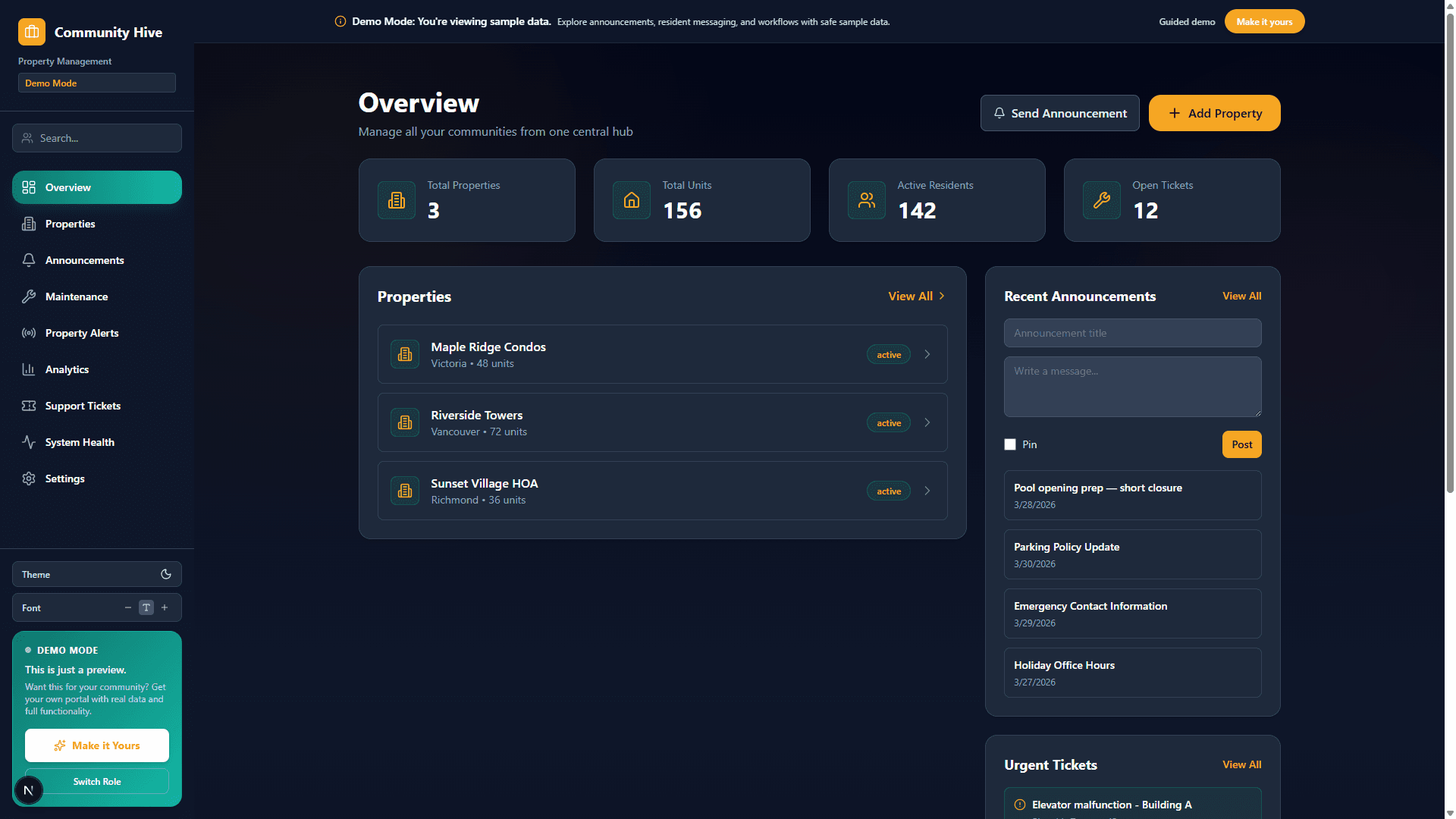
Consider something as ordinary as a maintenance problem. A resident reports an issue. Someone has to receive the information, determine who should deal with it, pass it along, keep track of what happens next, communicate with the resident, and eventually confirm that the problem has been resolved.
None of those individual tasks is particularly difficult. The difficulty comes from everything that has to happen around the actual repair.
Community Hive brings those steps into a connected process. A report can become a trackable issue, the appropriate people can be notified, its status can be followed, communication can be recorded, and the resolution can be documented. The point isn't that property managers need another place to enter information. It is that the process can be designed so that information follows the work instead of people having to continually move the information around themselves.
The same thinking can apply to other parts of property management. Booking a shared facility, organizing community votes, communicating with residents, documenting issues or maintaining an audit trail can all involve surprisingly large amounts of coordination when handled through disconnected systems. Community Hive is one example of what happens when those processes are considered as a whole rather than as a collection of separate administrative tasks.
And it doesn't have to be property management
The underlying question has very little to do with property management. A manufacturer might spend hours transferring information between orders, production schedules and reports. A professional service firm might have people repeatedly preparing information that already exists somewhere else. A retailer might be managing customer follow-ups, inventory information or supplier communication through a mixture of software, spreadsheets and email. A service business might know exactly what needs to happen after a customer makes an inquiry, yet still rely on someone remembering each step.
In each case, the issue isn't necessarily a lack of software. It may be that the available software was never designed around that particular way of working.
And that is where the change becomes interesting. The question is no longer simply, “What software can we buy?” It can also be, “What would make this process work better, and what is now possible that wasn't practical before?”
Sometimes the answer may be surprisingly simple. And sometimes it may lead to software built specifically around the problem. That possibility is much more accessible than it once was.
Start with the problem
The most useful place to begin isn't with a software package or a list of features. It is with the work itself. What takes too long? What gets repeated? What falls through the cracks? What requires unnecessary coordination? What information is already available but isn't being used effectively?
Those aren't merely annoyances to be tolerated. They may be telling you where the next improvement is hiding.
Have a process that isn't working as well as it should?
Let's discuss what software could improve.